
11:00 – 12:00, 10th March 2026, Online webinar
Watch the webinar
The maritime industry is no longer just about steel and salt; it is becoming a high-tech frontier of automation, electrification, and digital intelligence. As we move through 2026, the shift toward a “Net Zero” maritime sector is accelerating, driven by the commercialisation of hydrogen systems, high-voltage battery banks, and AI-driven autonomous navigation.
However, a critical question remains: Is our workforce ready?
While technology moves at the speed of software, human skillsets and academic curricula often follow a different pace. This webinar, co-organized by MarRI-UK and IEMA, brings together the architects of these new technologies and the educators shaping the next generation to bridge the “skills gap” before it becomes a barrier to progress.
The webinar is chaired by MarRI-UK Strategic Advisor, Richard Westgarth, who previously served as Chair of the MarRI-UK Technical Group before his retirement.
Why this webinar matters now?
The maritime landscape has reached a tipping point where traditional mechanical expertise is no longer enough. We are seeing:
- A shift in power: The transition from internal combustion to hybrid and fully electric propulsion requires a new breed of “Electro-Technical” officers and engineers.
- The data deluge: Digitalisation and “Digital Twins” are now standard in vessel management, requiring crew and onshore staff to be as comfortable with data analytics as they are with a wrench.
- The global race for talent: As nations accelerate their transition toward green shipping, the hunt for expertise has transcended borders—the competition for skilled talent is no longer local, it is global..
This session serves as a vital pulse check to ensure that the “Engine Room of the Future” is staffed by a workforce that is trained, agile, and aligned with industry reality.
What we will cover
1. The reality on the ground
Industry leaders from EPTechnologies and Torqeedo will reveal the most urgent hiring “pain points.” We’ll discuss why certain roles remain stubbornly difficult to fill and which competencies—from mechatronics to software troubleshooting—are now non-negotiable for new hires.
2. The academic response
Experts from the University of Strathclyde and Newcastle University will showcase how higher education is pivoting. Discover how curricula are being “future-proofed” and where universities are successfully integrating emerging themes like maritime cyber-security and sustainable systems engineering.
3. The alignment roundtable
A candid debate on whether academia and industry are truly speaking the same language. We will explore:
- How to create more “porous” boundaries through joint labs and internships.
- The role of micro-credentials versus traditional degrees.
- How the UK’s talent pipeline compares to international competitors.
4. Mapping the 2030 workforce
We look over the horizon to define the job titles of tomorrow—such as Hybrid Systems Specialists and Automation Supervisors—and discuss how we can co-create the training pathways required to support them.
Register
To register for the webinar, click here.
Panelists
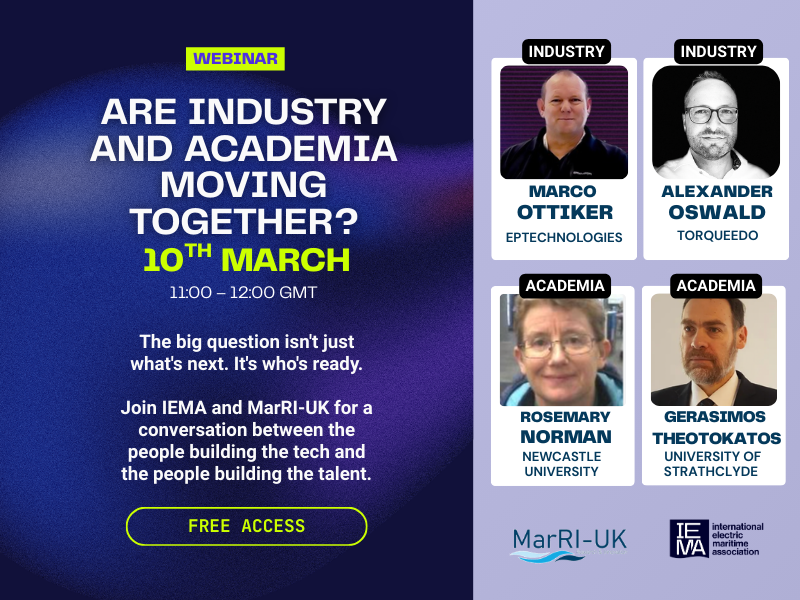
We are fortunate to have four very knowledgeable speakers to join the webinar:
Alexander Oswald (Torqeedo): Dr. Alexander Oswald is the Senior Vice President of Development & Global Service at Torqeedo, where he leads the development of innovative low and high-voltage electric and hybrid drive systems for marine applications. With a strong background in electrical engineering and information technology, he has held several leadership roles within the company, including Vice President of High Voltage Products and Vice President of Global Service and Application Engineering.
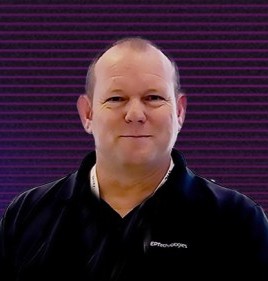
Marco Ottiker is the COO and Co-owner of EPTechnologies. He specialises in high-level system design, battery architecture, and the delivery of large-scale marine power solutions. An electrical engineer, sailor, Aviator with 20 years commercial airline pilot experience. With over 35 years of boating experience—including two years living aboard his own catamarans—Marco bridges the gap between technical engineering and the practical, real-world challenges faced by vessel owners. His expertise is focused on creating “clever,” integrated propulsion systems that prioritize efficiency without compromising on the robustness required for the open sea.

Dr Rosemary Norman is a Reader in Marine Electrical Systems. She joined Newcastle University in 2004 following a decade in industry, where she specialised in motor drive systems, power electronics, and embedded software. Her industrial work, particularly in the sensorless control of switched reluctance machines, resulted in multiple patents granted in both Europe and the USA. At Newcastle, her research focuses on the intersection of electrical engineering and maritime sustainability. Her expertise spans marine renewable systems, specifically tidal current turbines, as well as the development of hybrid marine propulsion and shore-to-ship power supplies. Rosemary’s diverse project portfolio includes marine robotic systems for hull maintenance (HISMAR), thermal ballast water treatment, and fuel-emission monitoring systems developed in collaboration with Innovate UK.
Professor Gerasimos Theotokatos is the DNV Professor of Safety of Marine Systems at the Maritime Safety Research Centre (MSRC) within the University of Strathclyde. A graduate of the National Technical University of Athens with a PhD in Marine Engineering, his research focuses on the holistic interplay between safety, energy, and sustainability in complex marine environments. He specialises in developing advanced model-based methods and “Digital Twin” tools for the design and optimization of cyber-physical and autonomous systems. His work is instrumental in driving life-cycle risk management and efficiency improvements, ensuring that the next generation of maritime technologies—from autonomous vessels to hydrogen-diesel combustion—remains safe, sustainable, and high-performing.